10 Key Benefits of Implementing ERP Software in Your Company
Discover 10 ERP software benefits for your company, from better efficiency and lower costs to a single source of truth and faster, smarter decisions.

With business competition getting tougher as of Friday, August 29, 2025, every investment decision has to be weighed carefully, especially those involving technology. Many business owners and managers have heard how important ERP software (Enterprise Resource Planning) is, but still wonder: "What real benefits will I get? Is this investment worth it?" It is a very fair question. Implementing ERP is a significant strategic step, and understanding its concrete benefits is the key to making the right decision.
ERP is more than software; it is a fundamental transformation in the way a company works. It integrates processes that used to be separate, gives you visibility you never had before and, in the end, builds a solid foundation for sustainable growth. Here are the 10 main benefits your company will see after successfully implementing ERP software.
1. Better Efficiency and Productivity
This is the quickest and most noticeable benefit. ERP automates repetitive, time-consuming manual tasks. Imagine your team no longer entering the same data into several systems or manually reconciling reports from different spreadsheets. Workflows become smoother and standardized, so employees can get more done in less time with fewer errors. They can move from administrative tasks to more strategic work.
2. 360-Degree Business Visibility (Single Source of Truth)
Before ERP, data was often scattered across isolated "islands": sales data in a CRM, stock data in Excel, financial data in accounting software. That makes it hard for management to get a complete, accurate picture of the company's condition. ERP breaks down these silos and creates one centralized single source of truth. Data from every department flows into one integrated database, giving you 360-degree, real-time visibility across the whole business.
3. Faster, More Accurate Decision Making
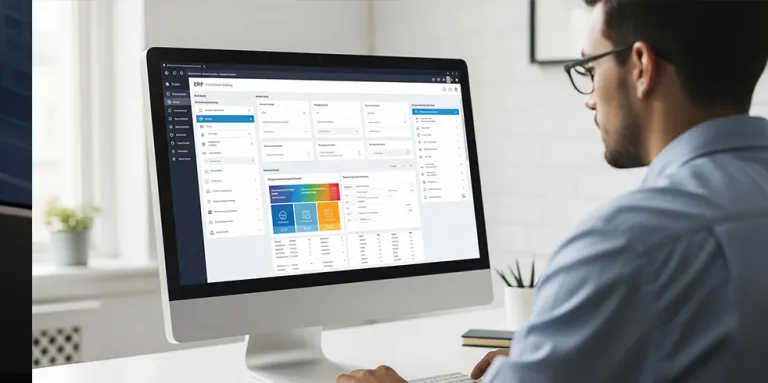
With centralized, real-time data, decision makers no longer need to rely on intuition or outdated reports that took days to compile. They can open analytics dashboards showing current information on sales, inventory levels, cash flow and other key metrics. Getting quick answers to crucial business questions makes the company more agile and responsive to market changes.
4. Significant Operating Cost Savings
The efficiency ERP creates translates directly into cost savings. Studies by Panorama Consulting consistently show that one of the main reasons companies adopt ERP is to reduce operating costs. The savings come from several areas:
- Inventory management: Lower storage costs from excess stock (overstocking) and fewer lost sales from empty shelves (understocking).
- Procurement: Better visibility allows better price negotiations with suppliers and more planned purchasing.
- Labor costs: Fewer hours spent on manual and administrative tasks.
5. Better Customer Service
Satisfied customers are the key to a sustainable business. ERP empowers your team to deliver superior service. When a customer calls, the customer service team can quickly see their whole history: previous orders, current delivery status, payment history and any complaints filed. With complete information at their fingertips, the team can solve problems faster and offer a more personal, satisfying experience.
6. Better Risk Management and Compliance
In a business environment full of regulation, compliance is a must. ERP helps mitigate risk by providing:
- Tight financial controls: Standardized processes reduce the risk of fraud.
- Audit trail: Every transaction is recorded digitally, making internal and external audits easier.
- Regulatory compliance: Financial and operational reporting stays in line with current standards.
7. Smoother Collaboration Between Departments
Without ERP, each department is like a small kingdom with its own language and currency. Sales speaks the language of "targets," production speaks "capacity," and finance speaks "budget," often with data that does not match. ERP steps in as a universal translator and central bank, bringing them all into one cohesive ecosystem. When everyone works from the same data, miscommunication falls, collaboration improves and the company moves as one solid unit toward shared goals.
8. Scalability to Support Growth
Many fast-growing businesses eventually "hit a wall" because their systems and manual processes can no longer handle rising transaction volumes. Modern ERP software, especially cloud-based, is designed for scalability. It can easily be adjusted to accommodate more users, new products, new branches or even expansion into international markets, without overhauling your entire IT infrastructure. It is a foundation that lets your business grow without limits.
9. Optimal Inventory and Supply Chain Management
For retail, distribution or manufacturing companies, inventory is both an asset and a cost. ERP provides advanced tools to manage it well. The system can automatically monitor stock levels, trigger reorders when they reach a minimum point and help forecast future demand from historical data. The result is a healthier inventory turnover cycle, better cash flow and more reliable fulfillment of customer orders.
10. Centralized, Managed Data Security
Keeping crucial business data in scattered spreadsheets and local computers is a recipe for a security disaster. ERP provides a centralized platform where data security can be managed far better. You can set role-based access controls so that only authorized employees can view or change sensitive data. Cloud ERP providers also invest heavily in infrastructure security, protecting your data from cyber threats to a standard that is hard for the in-house IT team of a small or medium company to match.
Conclusion: An Investment in Competitive Advantage
Taken together, these 10 benefits show that implementing ERP software is not just an IT expense but a strategic investment in building a more efficient, smarter and more resilient company. By integrating every aspect of your business, ERP creates a lasting competitive advantage, letting you not just survive but thrive amid the challenges of the modern market.
To make sure your company captures all of these benefits, your ERP software implementation should be guided by an experienced partner who understands your business's unique needs. The expert team at Metrodata is ready to be your strategic partner, supporting you from planning through successful implementation so you can realize your company's full potential.