Home Water Pump Maintenance: How It Works and a Checklist
Water pump maintenance made clear: how an automatic pump works, a checklist from manufacturer manuals, safety basics and a symptom table for repair guides.

Written by Fajar Webarq. Updated October 26, 2026.
Summary
Contents
- An automatic water pump works as one system: the foot valve holds water in the suction pipe, the pump pushes water to the tank, and the pressure switch turns the motor on and off.
- The manufacturers we referenced do not give a fixed maintenance schedule. Maintenance means keeping the suction line sealed, the pump protected and the tank's air charge correct.
- The symptom table below points you to the right repair guide.
This page is the entry point to all the water pump guides on article.id, focused on automatic shallow-well jet pumps that use a pressure switch and a pressure tank. It covers how the system works, a maintenance checklist sourced from manufacturer manuals, safety basics and a symptom table that leads to repair guides.
How an Automatic Water Pump Works
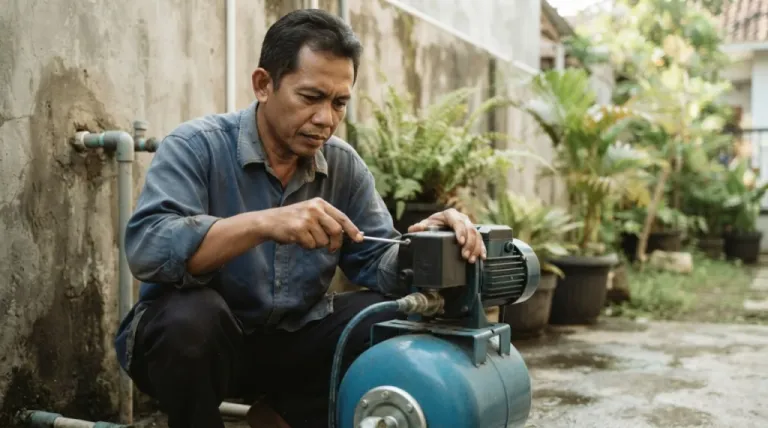
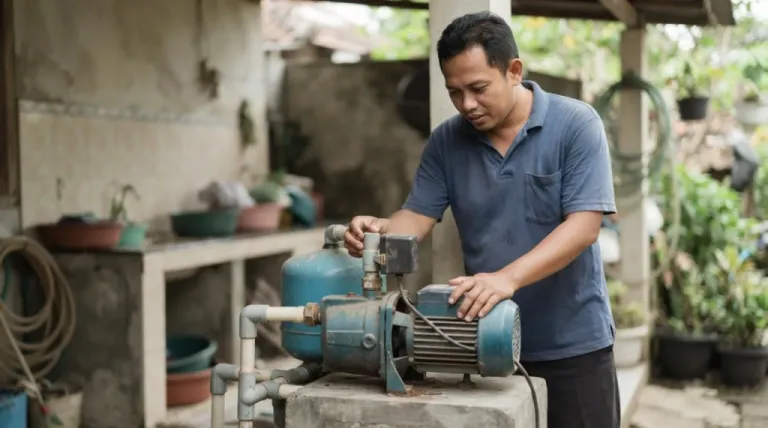
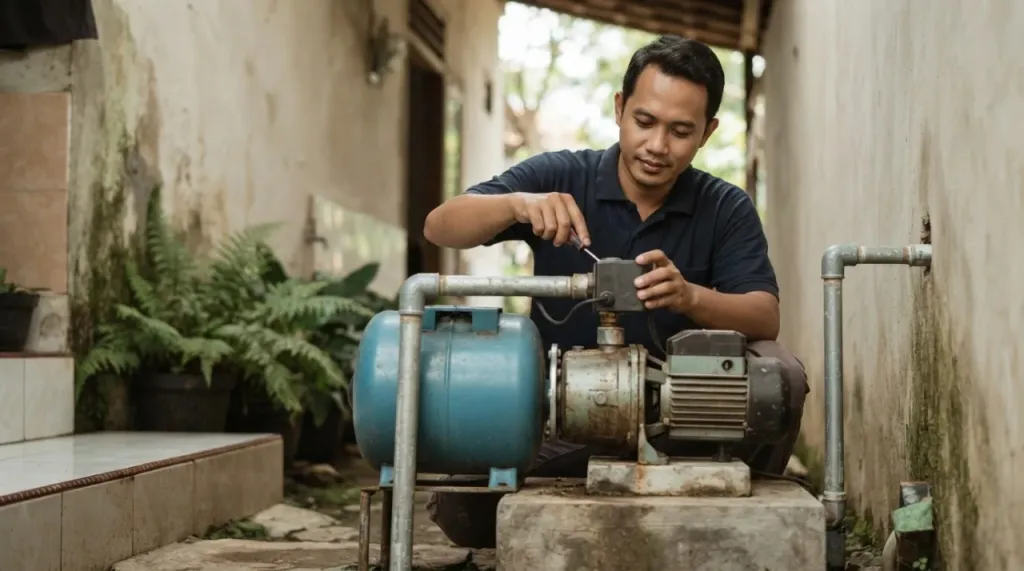
An automatic water pump draws well water through a suction pipe, pushes it to the tank and the household pipes, and shuts itself off when pressure reaches the upper limit. When a tap is opened and pressure falls to the lower limit, the pressure switch starts the pump again. The five components below determine whether this cycle runs smoothly.
| Component | Location | Brief function |
|---|---|---|
| Foot valve and strainer | Bottom end of the suction pipe, inside the well | A one-way valve that holds water in the suction pipe when the pump stops; the strainer keeps out debris |
| Priming water | Pump housing and suction pipe | Water poured in before the pump is first started so that it can begin drawing |
| Check valve | In the pump body | A one-way valve; if it does not seal tightly, the pump can start even though no tap is open |
| Pressure tank | Built into the pump or installed separately on the discharge pipe | Stores pressurized water with an air cushion so the pump does not cycle on and off too often |
| Pressure switch | On top of the pump | Starts the motor when pressure falls to the lower limit and stops it at the upper limit |
For example, the Shimizu PS-255 BIT manual lists settings of ON 1.4 kgf/cm² and OFF 2.2 kgf/cm², and names the air charger and air chamber as components without explaining their functions in detail.
Routine Water Pump Maintenance Checklist
Maintaining a home water pump basically means keeping three things in order: the suction line stays sealed and clean, the pump is protected from water and heat, and the tank's air pressure is correct. The manufacturers we referenced do not list a monthly or yearly schedule, so this checklist is organized by event, not by date.
| What to check | When | Basis |
|---|---|---|
| Suction and discharge pipe connections are not leaking | When the pump runs with nothing in use, or priming starts being lost often | Shimizu PS-255 BIT and PS-221 BIT manuals |
| Strainer and foot valve are not clogged | When water flow weakens or the pump struggles to draw | Shimizu PS-221 BIT; Grundfos JP PS |
| A sand strainer is fitted on the suction pipe | If the well carries a lot of sand or debris | Shimizu |
| Well water level compared with the pump's suction capability | Ahead of and during the dry season | Shimizu |
| Pump is shielded from rain and sun, not wrapped in cloth, and sits on a cement base about 10 cm high | At installation and during renovations | Shimizu |
| Tank air pressure | When the pump starts cycling on and off often | Shimizu PT-190 BIT; K2 Pumps |
| Motor shaft turned with a screwdriver while the power is off | Before starting a pump that has not been used for a long time | Shimizu |
| Electrical voltage | If the thermal protector often cuts out the motor | Shimizu: permitted voltage is ±10% of spec |
The Grundfos JP PS manual (10/2025) says that jet pump is maintenance-free in normal operation and only needs to be wiped with a dry cloth. So maintenance at home is mostly observation: does the pump start with nothing in use, does the water weaken, or is there any seepage.
Find the Problem by Symptom
If your pump already has a problem, match its symptom to the table below to find the right guide. Each guide orders the checks from the easiest and cheapest, and ends with a clear line for when you should stop checking yourself and call a technician.
| Symptom | Guide |
|---|---|
| The pump runs constantly even though all taps are closed | Water pump won't turn off |
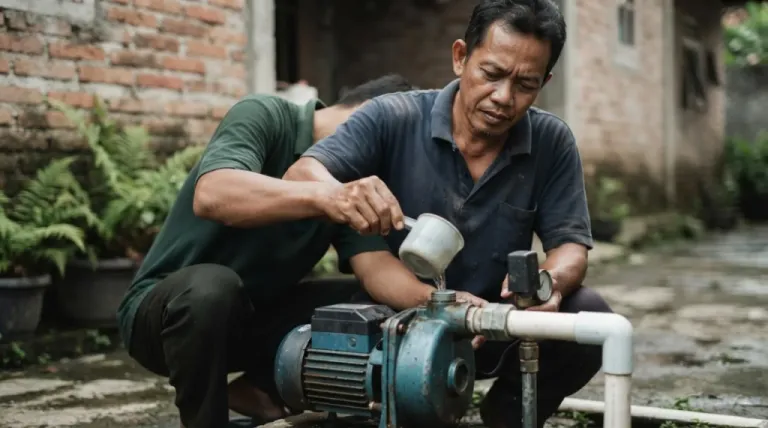
| The pump has to be primed every time it is used, or will not draw water | Water pump keeps needing priming |
| The pump cycles on and off within seconds, with a clicking sound | Water pump keeps cycling on and off |
Water pump won't turn off
A pump that keeps running means the upper pressure limit is never reached, or the switch is not reading that pressure. This guide covers seven causes, from leaking taps and toilets, the check valve, priming and suction power to the pressure switch, complete with a tap shut-off test.
Water pump keeps needing priming
Priming that keeps getting lost means water in the suction pipe is not being held, or air is entering the suction line. This guide covers the foot valve, suction pipe connections, well water level and the seal, plus step-by-step priming according to the Shimizu and Grundfos manuals.
Water pump keeps cycling on and off
A cycle of on and off within seconds is usually linked to too small a pressure reserve. This guide covers six causes, how to measure the tank's air pressure with a tire pressure gauge, a table of target pressures in psi, bar and kgf/cm², and safe limits for a rusted tank.
Safety Basics When Maintaining a Pump
A water pump combines electricity, water and pressure, so safety starts with cutting the power and releasing pressure before touching any part. The rules below are drawn from the Shimizu, Grundfos and Amtrol manuals, and apply to all the checks covered across article.id's water pump guides.
- Cut the power and make sure it cannot switch on by accident. Shimizu advises connecting the pump cable to a disconnect switch.
- Release pressure before disassembling, by draining the system or closing the isolation valve (Grundfos).
- Use a grounded outlet. Grundfos requires that electrical connections be done by a qualified person according to local regulations.
- A damaged cable should only be replaced by the factory, a service center or a qualified person (Shimizu).
- The pump is for water only. Shimizu prohibits pumping gasoline or oil because it can cause a fire, and prohibits wrapping the pump in cloth.
- Do not add air to a rusted tank. Amtrol warns that such a tank can burst.
Frequently Asked Questions
How do you maintain a water pump?
Follow the checklist above: tight connections, a clean strainer and foot valve, a protected pump and the right tank air pressure. Avoid running the pump for long without drawing water, which Shimizu says shortens the pump's life.
What does the tank on an automatic water pump do?
The tank, or pressure tank, stores pressurized water with an air cushion, so a tap can be used briefly without the pump starting right away. The Shimizu PT-190 BIT manual links the pressure tank to preventing the pressure switch from cycling on and off too often.
How does the automatic switch on a water pump work?
The pressure switch reads the water pressure at the pump. When a tap is opened and pressure drops below the lower limit, the switch starts the motor; when pressure reaches the upper limit, the switch stops it. The limit values differ by model.
How long can a water pump run?
The manufacturers we referenced do not give a standard time limit. Grundfos only limits the JP PS pump to running without delivering water for 5 minutes at most and to 20 starts and stops per hour at most.
Next Steps
Start with the symptom that bothers you most right now: water pump won't turn off, water pump keeps needing priming or water pump keeps cycling on and off.