Water Pump Keeps Losing Prime? Causes and How to Fix It
Water pump keeps losing prime? Check a leaking foot valve, air in the suction pipe, a falling well water level and a worn seal, then prime the pump right.

Written by Fajar Webarq. Updated October 26, 2026.
Summary
Contents
- A household jet pump needs to be primed only once. If the prime keeps disappearing, the water in the suction pipe is not being held, or air is getting into the suction line.
- Causes according to manufacturer manuals: a leaking foot valve, loose suction pipe joints, a well water level that is too low, a leaking seal, and an incorrect priming method.
- Don't let the pump spin for long without water. Grundfos limits the JP PS jet pump to a maximum of 5 minutes of running without delivering water.
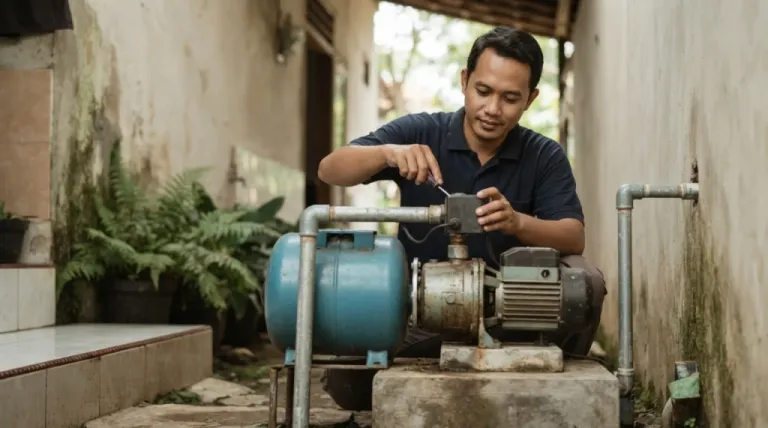
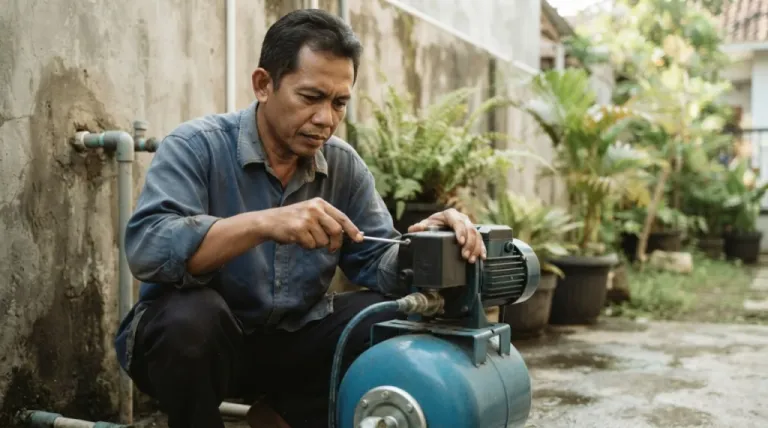
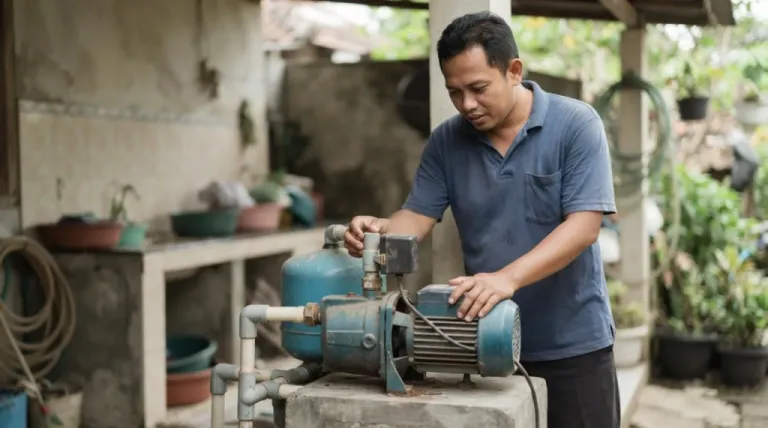
A water pump that has to be primed over and over is losing water in its suction line, either because water drains back into the well through a leaking foot valve or because air is being drawn in through pipe joints and seals. A jet pump is designed to draw by itself after the first prime, so repeated priming is a symptom of a problem, not a normal habit. This guide orders the checks from what you can do yourself to what needs a technician.
Why Does a Water Pump Keep Needing to Be Primed?
A water pump has to be primed again and again because the water in the pump housing and suction pipe doesn't stay there. Priming water is needed for the pump to pull water up from the well. Once that water is gone, whether it drains back into the well or is pushed out by air getting in, the pump only spins without drawing, and you have to prime it again.
The K2 Pumps jet pump FAQ explains that a jet pump can draw by itself only after it has been primed the first time, provided the pump housing and suction pipe are completely full of water. What holds that water in place is the foot valve, a one-way valve at the bottom end of the suction pipe. According to the KSB pump lexicon, this valve keeps the suction pipe from emptying after the pump stops.
The most useful clue is when the prime is lost. If the pump is normal while in use but has to be primed again after sitting idle for a long time or after a power outage, suspect the foot valve or a leak in the suction pipe. InspectAPedia, a technical reference for home inspection, notes that losing prime during a power outage usually means a leaking well pipe or a faulty foot valve. If the pump never manages to draw even though you have primed it full, check for air leaks, the slope of the pipe, and the well water level.
Table of Causes for a Water Pump That Keeps Losing Prime
This table summarizes the five causes that manufacturer manuals list for a pump that loses its prime or won't draw. Match the symptom you see, then start with the causes you can check yourself. The last column shows whether the check is safe to do without taking the pump apart.
| # | Symptom you see | Likely cause | Can you check it yourself? |
|---|---|---|---|
| 1 | The pump works normally while in use, but has to be primed again after sitting idle for a long time or after a power outage | A leaking foot valve, so the water in the suction pipe drains back into the well | Partly; depends on whether the suction pipe can be lifted out |
| 2 | Primed full and the pump runs, but no water comes out, or it comes out briefly and then stops | Air entering through a joint or crack in the suction pipe, or an air pocket forming because the pipe slopes downward toward the pump | Yes, for joints you can see |
| 3 | The problem starts or gets worse in the dry season, and only a weak flow comes out | The well water level has dropped below the pump's suction limit | Partly |
| 4 | Water seeping from the pump body near the motor, with a weak flow or none | Air being drawn in through a leaking mechanical seal | No; call a technician |
| 5 | The pump is switched on before the housing is full, or the priming cap is not tightened | Incorrect priming method | Yes |
Causes 1 and 2 are listed in the troubleshooting tables of the Grundfos JP PS manual (10/2025) and the Everbilt EB-0185 guide (09/2024). Causes 2, 3 and 4 appear in the fault tables of the Shimizu PS-255 BIT and Shimizu PS-221 BIT manuals. Cause 5 is a departure from the priming steps in the same manuals. A pump that keeps running without drawing water is covered in water pump won't turn off.
Diagnosis Steps, Easiest First
Start with the checks that need no disassembly: the priming method, the pipe joints you can see, and the depth of the well water. The foot valve and seal checks come after that because they require lifting the pipe or opening the pump. Stop at the step that finds the problem, and note the result of each step for the technician in case you need one later.
- Switch off the power first. Unplug the pump or flip its circuit breaker (MCB) before opening the priming cap or any joint. Grundfos asks you to make sure the power cannot be switched on by accident and to release system pressure before taking pump parts apart.
- Repeat the priming as the manual describes. Follow the order in the priming section below. If the pump draws right away and the prime doesn't disappear again, the cause was most likely the earlier priming method.
- Note when the prime is lost. If the pump is normal while in use but loses its prime after a night of not running or after a power outage, focus the check on the foot valve and suction pipe (step 6). If the pump never manages to draw, go on to steps 4 and 5.
- Check the suction pipe joints you can see. Look for cracks, joints where the glue has come loose, and threads that aren't tight. The Shimizu manual asks owners to make sure the pipe joints don't leak, and Grundfos recommends sealing threaded joints with seal tape. Also look at the slope: Grundfos recommends that the suction pipe rises gently toward the pump, because a pipe that slopes downward creates air pockets.
- Compare the water depth with the pump's suction lift. Suction lift is listed as 9 meters for the Shimizu PS-221 BIT and the Panasonic GA-126JAK, 8 meters including pipe losses for the Grundfos JP PS, and 25 feet (about 7.6 meters) for K2 Pumps. Process Engineering notes a practical limit of about 7 to 8 meters. Measure from the water surface, not the bottom of the well, because the pump draws from the water surface (K2).
- Check the foot valve. If the suction pipe can be lifted out, see whether the strainer is clogged and whether the valve closes tightly. Grundfos suggests cleaning a clogged foot valve, while Everbilt and K2 suggest replacing it if it leaks. If the pipe is buried or hard to reach, leave it to a technician.
- Check for seepage near the motor and the check valve. The Shimizu PS-255 BIT manual says air can be drawn in through the mechanical seal, and that a leaking check valve keeps water from being pumped (the fix is to clean the check valve and its seat). Grundfos notes that seal seepage of up to 10 ml per day can still occur on JP PS pumps, so watch whether the seepage increases. Replacing a seal is a technician's job.
How to Prime a Water Pump Correctly
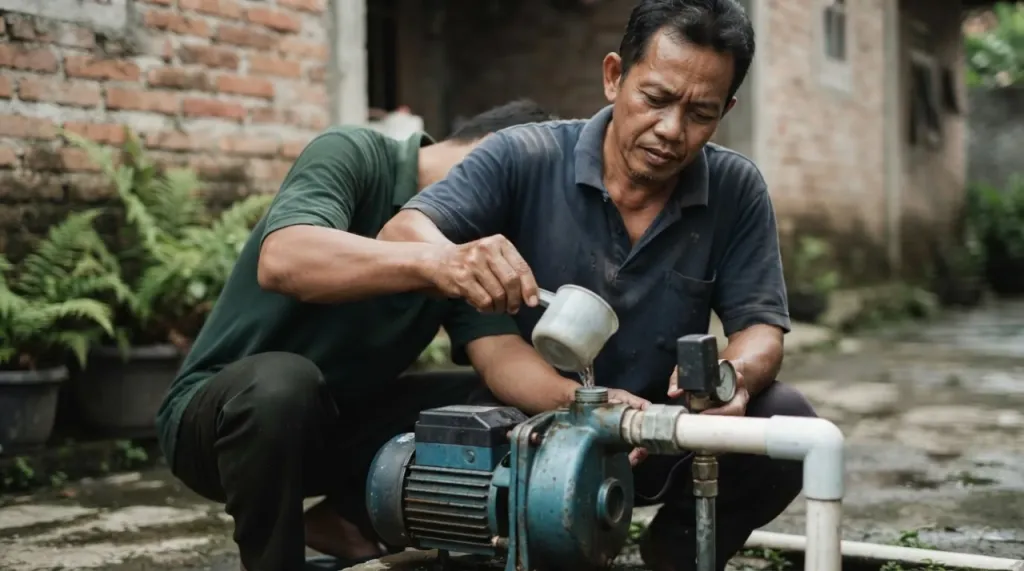
The correct way to prime is to fill the pump housing completely, put the priming cap back on tightly, close all taps, then switch on the pump and wait until water is drawn. This order appears in the Shimizu manual, and Grundfos adds that the power should only be switched on after the pump is filled with water.
- Switch off the pump's power.
- Open the cap of the priming port (the hopper cap or plug), then pour water into the pump housing until it is full. K2 Pumps says the housing and suction pipe must be completely filled before the pump is started.
- Put the cap back on. Grundfos says to tighten the priming cap by hand.
- Close all taps, switch on the pump, and wait a moment until the pump draws water.
- Open a tap slightly. If no water comes out, Shimizu says the priming water may have been too little, so switch off the pump and repeat from step 2.
Don't let the pump run for long while you wait. Grundfos limits the JP PS pump to a maximum of 5 minutes of running without delivering water, and Shimizu asks users to avoid running the pump for long without drawing water because it shortens the pump's life. If the pump uses the Shimizu SC-015 E automatic control, the control switches the pump off by itself if it hasn't drawn water within 8 minutes, and you restart the pump with the RESET button.
When to Call a Technician
Call a technician if the problem lies in parts that have to be taken apart or are hard to reach, such as the pump seal and a foot valve on a buried pipe, or if the pump simply cannot reach the water level. The conditions below should also be handled by a qualified person because they involve electricity and water pressure.
- Seepage from the pump body near the motor keeps getting worse.
- The foot valve is on a pipe you can't lift out yourself.
- The well water level is already below the pump's suction lift. The Shimizu PS-221 BIT manual advises replacing the pump with one whose suction lift suits the water depth.
- The pump smells burnt, or its thermal protector often cuts out the motor.
- The pump cable is damaged. Shimizu restricts replacing the supply cable to the factory, a service center, or a qualified person.
How to Keep a Pump From Losing Prime
Prevention focuses on keeping the suction line tight, clean and free of air pockets. Most of the steps come from manufacturers' installation instructions, so they are easiest to apply when you install a new pump or when the suction pipe is being taken apart for repair, by you or by a technician.
- Fit a foot valve with a strainer at the end of the suction pipe, as Shimizu and Grundfos recommend. If the well is sandy, Shimizu suggests an additional sand filter.
- Keep the suction pipe as short and straight as possible. Shimizu asks that the pump be installed as close to the well as possible and that pipe bends be kept to a minimum. Grundfos recommends a pipe that rises gently toward the pump.
- Use the pipe diameter in the specification. The Shimizu PS-255 BIT uses a 25 mm (1 inch) suction pipe. Grundfos asks for a pipe larger than 1 inch if the length is more than 10 meters or the suction height is more than 4 meters.
- Seal the joints with seal tape or a similar sealing material.
- Watch the water level before the dry season, as the Shimizu manual asks.
Frequently Asked Questions
Why does a water pump have to be primed first?
A jet pump needs a pump housing and suction pipe filled with water before it can start pulling water from the well. Priming water meets that need. Once primed, the pump draws by itself as long as the water in the suction pipe is held in place by the foot valve.
What does the foot valve do on a water pump?
A foot valve (called a tusen klep in Indonesia) is a one-way valve at the bottom end of the suction pipe, usually built into the strainer. It holds water in the suction pipe when the pump stops, so the pump doesn't need to be primed again every time it is about to start.
Why is my Shimizu water pump not drawing water?
The Shimizu PS-255 BIT and PS-221 BIT manuals list too little priming water, air drawn in through the suction pipe or mechanical seal, a well water level lower than the pump's suction capability, and a leaking check valve. The PS-221 BIT also lists a blocked pipe and a pipe opening that is too small. Start by priming again and checking the suction pipe joints.
Can a water pump be switched on without priming water?
It isn't recommended. Grundfos asks that the power be switched on only after the pump is filled with water, and limits running without delivering water to a maximum of 5 minutes. Grundfos also explains that running dry can damage the mechanical seal and the motor.
My Sanyo water pump isn't drawing water. Is the cause the same?
The causes in the table above come from the manuals of several shallow-well jet pump makers, not from one brand. We haven't found an official Sanyo manual, so match the priming steps and suction lift to the instruction book for your model.
Next Steps
If the pump now draws normally but often switches on and off within seconds, go on to water pump keeps turning on and off. All the pump maintenance guides are in the Home Water Pump Maintenance Guide.